Visualising a multiverse
As an example, we inspect the famous “Female hurricanes are deadlier than male hurricanes” multiverse from Simonsohn et al. (2020). The implementation of this multiverse is implemented in the Hurricane multiverse (non-neuroimaging) example below.
We start by loading the multiverse from memory and print the forking paths as a table:
[1]:
from comet import multiverse

mverse = multiverse.load_multiverse("example_mv_hurricane")
mverse.summary()
| Universe | Decision 1 | Value 1 | Decision 2 | Value 2 | Decision 3 | Value 3 | Decision 4 | Value 4 | Decision 5 | Value 5 | Decision 6 | Value 6 | Decision 7 | Value 7 | |
|---|---|---|---|---|---|---|---|---|---|---|---|---|---|---|---|
| 0 | Universe_1 | death_outliers | 2 | damage_outliers | 3 | femininity_rating | fem_likert | damage_functional | ln | effect_type | femininity * damages | year_interaction | NaN | model | log_linear |
| 1 | Universe_2 | death_outliers | 2 | damage_outliers | 3 | femininity_rating | fem_likert | damage_functional | ln | effect_type | femininity * damages | year_interaction | NaN | model | neg_binomial |
| 2 | Universe_3 | death_outliers | 2 | damage_outliers | 3 | femininity_rating | fem_likert | damage_functional | ln | effect_type | femininity * damages | year_interaction | + post1979:damages | model | log_linear |
| 3 | Universe_4 | death_outliers | 2 | damage_outliers | 3 | femininity_rating | fem_likert | damage_functional | ln | effect_type | femininity * damages | year_interaction | + post1979:damages | model | neg_binomial |
| 4 | Universe_5 | death_outliers | 2 | damage_outliers | 3 | femininity_rating | fem_likert | damage_functional | ln | effect_type | femininity * damages | year_interaction | + year:damages | model | log_linear |
| ... | ... | ... | ... | ... | ... | ... | ... | ... | ... | ... | ... | ... | ... | ... | ... |
| 1723 | Universe_1724 | death_outliers | 0 | damage_outliers | 0 | femininity_rating | fem_binary | damage_functional | linear | effect_type | femininity + damages + z3 | year_interaction | NaN | model | neg_binomial |
| 1724 | Universe_1725 | death_outliers | 0 | damage_outliers | 0 | femininity_rating | fem_binary | damage_functional | linear | effect_type | femininity + damages + z3 | year_interaction | + post1979:damages | model | log_linear |
| 1725 | Universe_1726 | death_outliers | 0 | damage_outliers | 0 | femininity_rating | fem_binary | damage_functional | linear | effect_type | femininity + damages + z3 | year_interaction | + post1979:damages | model | neg_binomial |
| 1726 | Universe_1727 | death_outliers | 0 | damage_outliers | 0 | femininity_rating | fem_binary | damage_functional | linear | effect_type | femininity + damages + z3 | year_interaction | + year:damages | model | log_linear |
| 1727 | Universe_1728 | death_outliers | 0 | damage_outliers | 0 | femininity_rating | fem_binary | damage_functional | linear | effect_type | femininity + damages + z3 | year_interaction | + year:damages | model | neg_binomial |
1728 rows × 15 columns
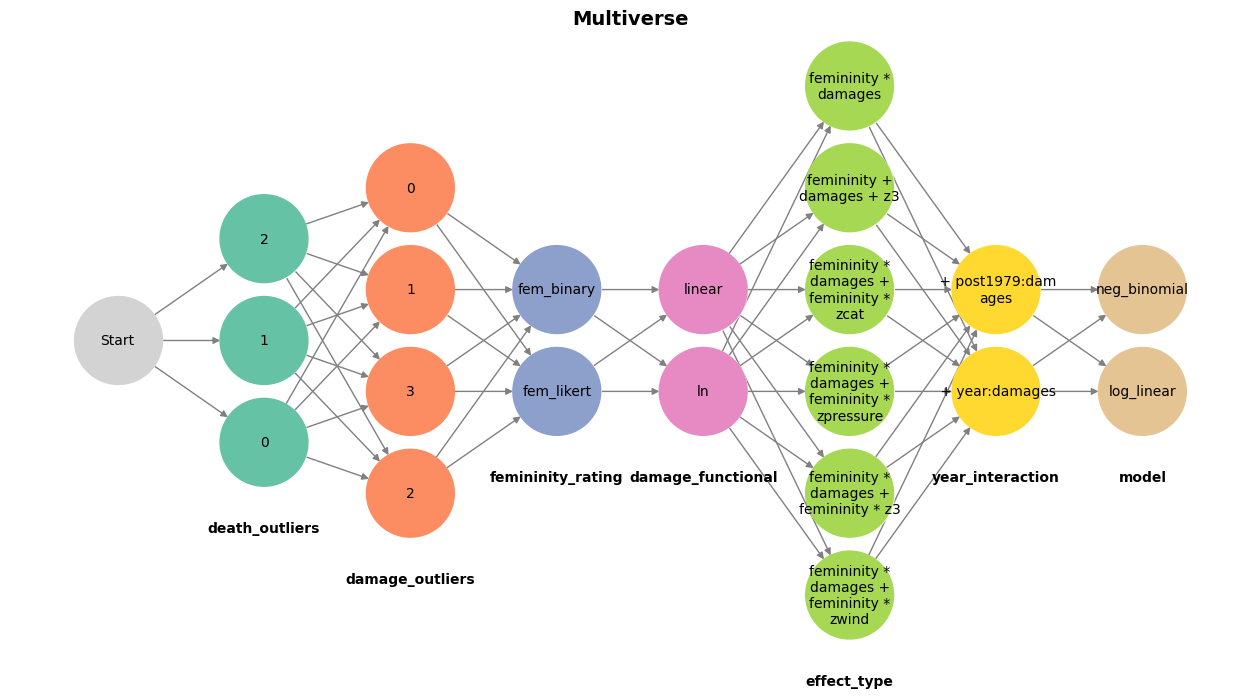
We can visualise the structure any linear multiverse as a feed-forward network:
[2]:
mverse.visualize(figsize=(16, 8), text_size=10, node_size=4000)
The results of a multiverse can be visualised with two main functions, namely a specification curve and a multiverse plot.
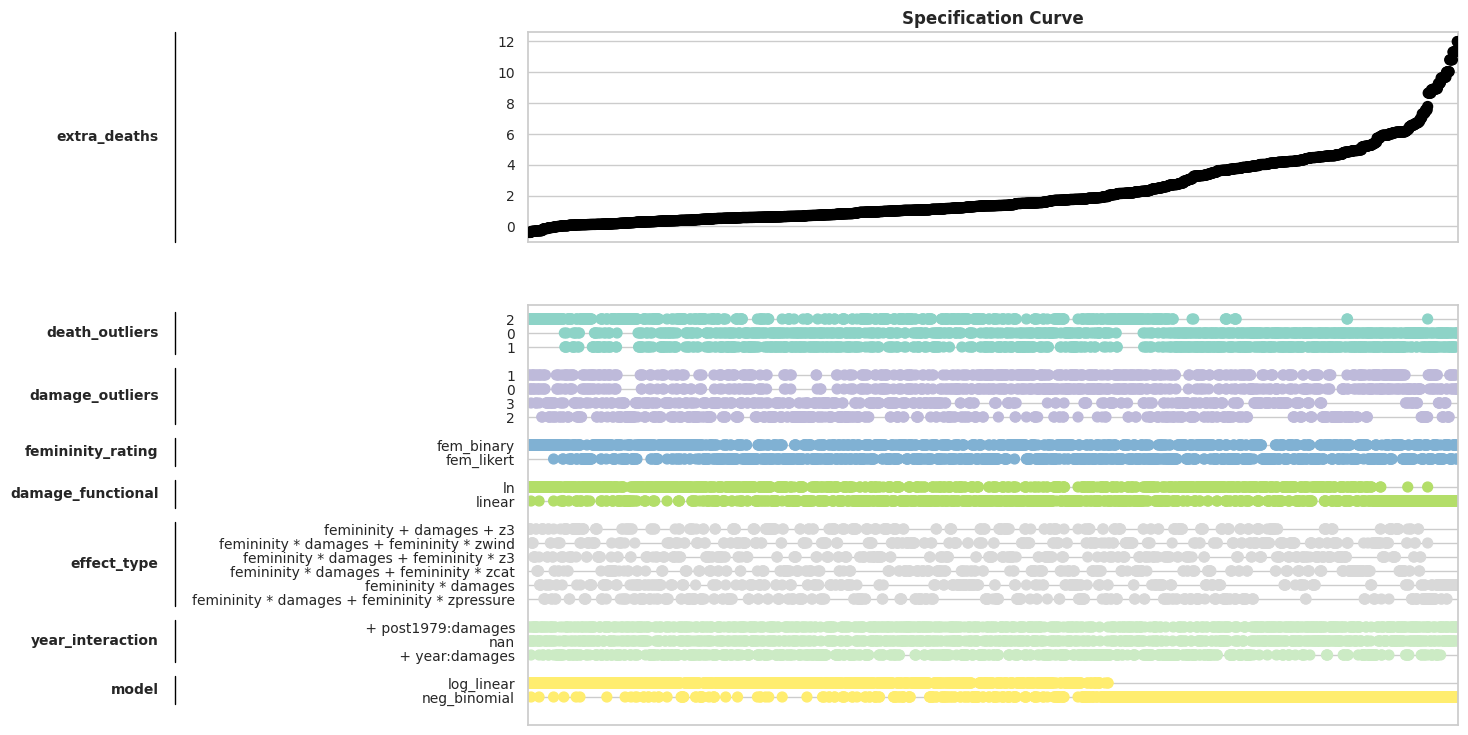
A traditional specification curve plots the results of each multiverse against the individual specification. This is often useful, but does not scale well with large multiverses like the present one:
[3]:
mverse.specification_curve("extra_deaths", figsize=(12,9), height_ratio=(1,2), line_pad=0.05)
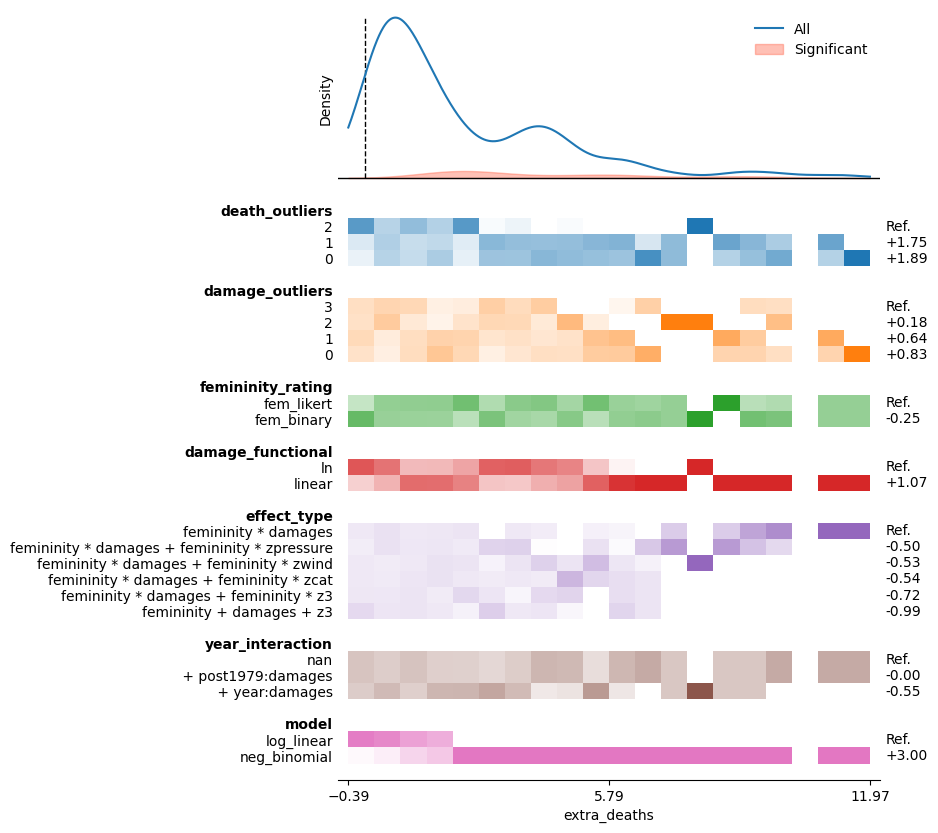
A more modern alternative is a multiverse plot, which visualises the results as a density function and groups the specifications into bins (Krähmer & Young, 2026). Here it becomes easily visible how most effects are close to 0 and not significant.
Krähmer, D., & Young, C. (2026). Visualizing vastness: Graphical methods for multiverse analysis. PLOS One, 21(2), e0339452. https://doi.org/10.1371/journal.pone.0339452
[4]:
mverse.multiverse_plot(measure="extra_deaths", n_bins=20, sig_col="p_val", baseline=0, figsize=(7,10))